
The IT Block That's Quietly Killing CFO AI Projects in 2026

Here's a pattern we've watched repeat over the last twelve months: a CFO commissions an agentic AI build. It works. Then it sits, because Finance and IT never actually agreed on who owns data access, who signs off on security, and what happens when something goes wrong.
The same gap shows up in the sector with the most resources and the most regulatory scrutiny to get it right. According to FIDE FORUM and Accenture Malaysia's “From Oversight to Advantage” (June 2026), 71% of Malaysian banks have implemented AI. Only 17% have successfully scaled it past the pilot stage. Among the insurers surveyed, none had scaled at all. If banks, with compliance teams, dedicated risk functions, and the deepest pockets in the market, are stalling this hard, budget alone was never going to fix it for a Finance team a fraction of that size.
The instinct is to treat this as a technology maturity question: better models, better vendors, better integration. That's rarely where the real constraint sits. What we've observed across recent agentic AI engagements in the region tracks with something EY's Dorian Redding has pointed out: much of this friction comes down to systems and approval processes built for a slower, more manual era being asked to keep pace with something that now operates continuously. The technology is usually ready well before the permissions structure around it is.
That's fixable, but only if it gets resolved before the contract is signed, not after the build is finished. We'd put three questions in front of any CFO before approving AI spend on a Finance process:
Who owns the data access sign-off for an agentic AI operating inside this process, and how long does that approval actually take?
When the agent makes a judgement call a human reviewer can't easily explain, what audit trail does the organisation require, and does it already exist?
If a model's output can't be reconciled to the underlying transaction data, what's the incident response, and who gets the call?
These are governance questions. IT can't answer them alone, and neither can Finance. They need to be answered together, and they need to be answered before procurement, not during a post-mortem on why a working build never went live.
Get this right and the redesign work underneath it gets easier too. Roles change, some responsibilities move to the agent, and the Finance talent freed up needs somewhere real to go: exception handling, anomaly review, the judgement calls a model still can't make on its own. None of that repositioning happens on schedule if the underlying data and security questions are still unresolved six months after go-live.
The mandate on Finance AI has moved past proving the model works, toward proving the organisation can run it safely, accountably, and fast enough that the board stops asking why a CFO AI project that worked in testing still hasn't shipped.
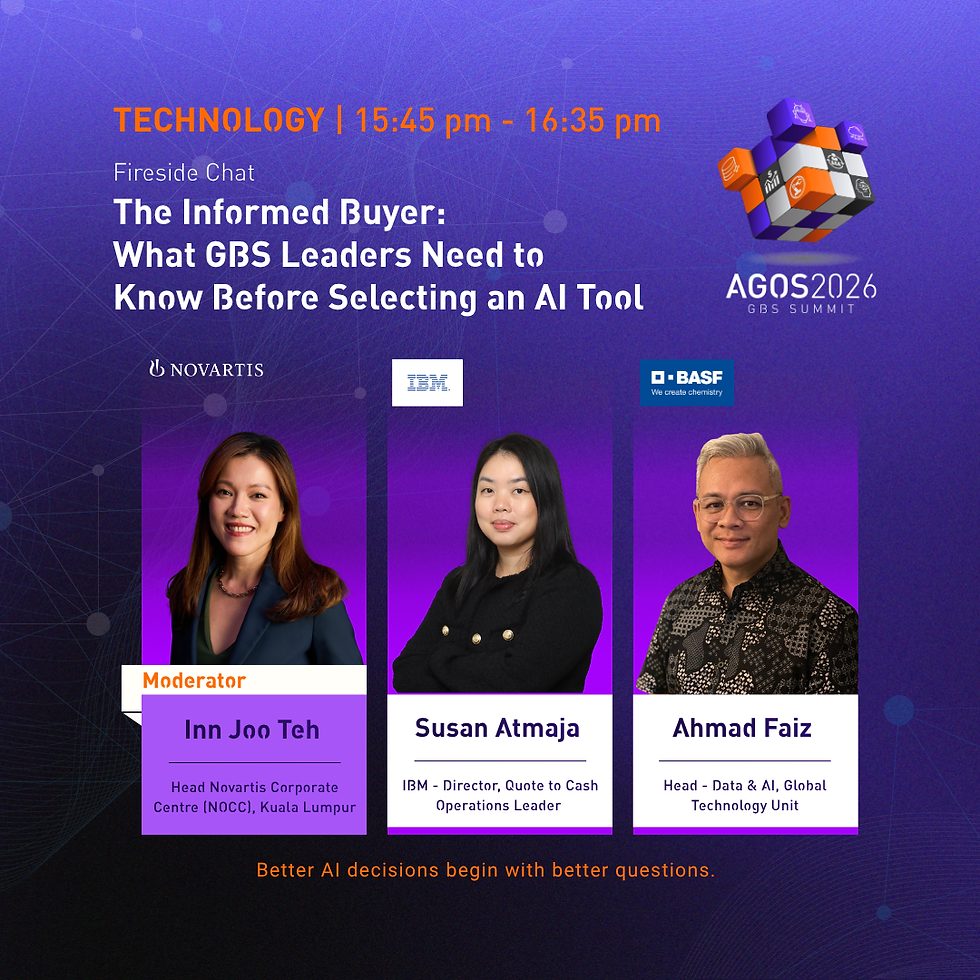
We'll be picking this up in person at the AGOS GBS Summit's Technology track, where Susan Atmaja and Faiz Fadzil sit down for The Informed Buyer: what an organisation actually needs to know before it signs.
About AGOS Asia
AGOS Asia is an AI-first GBS transformation partner working with CFOs and GBS leaders across ASEAN. AGOS hosts the 9th AGOS GBS Summit in Petaling Jaya on 10 September 2026. More at agosasia.com.


Comments